From Radiohead to Ragas: The Songs That Built Yyan from Where Water Meets
From writing punk rock songs on a guitar case to exploring 25-minute instrumentals, open tunings and cosmic existentialism, meet Yyan, one half of experimental folk duo Where Water Meets.
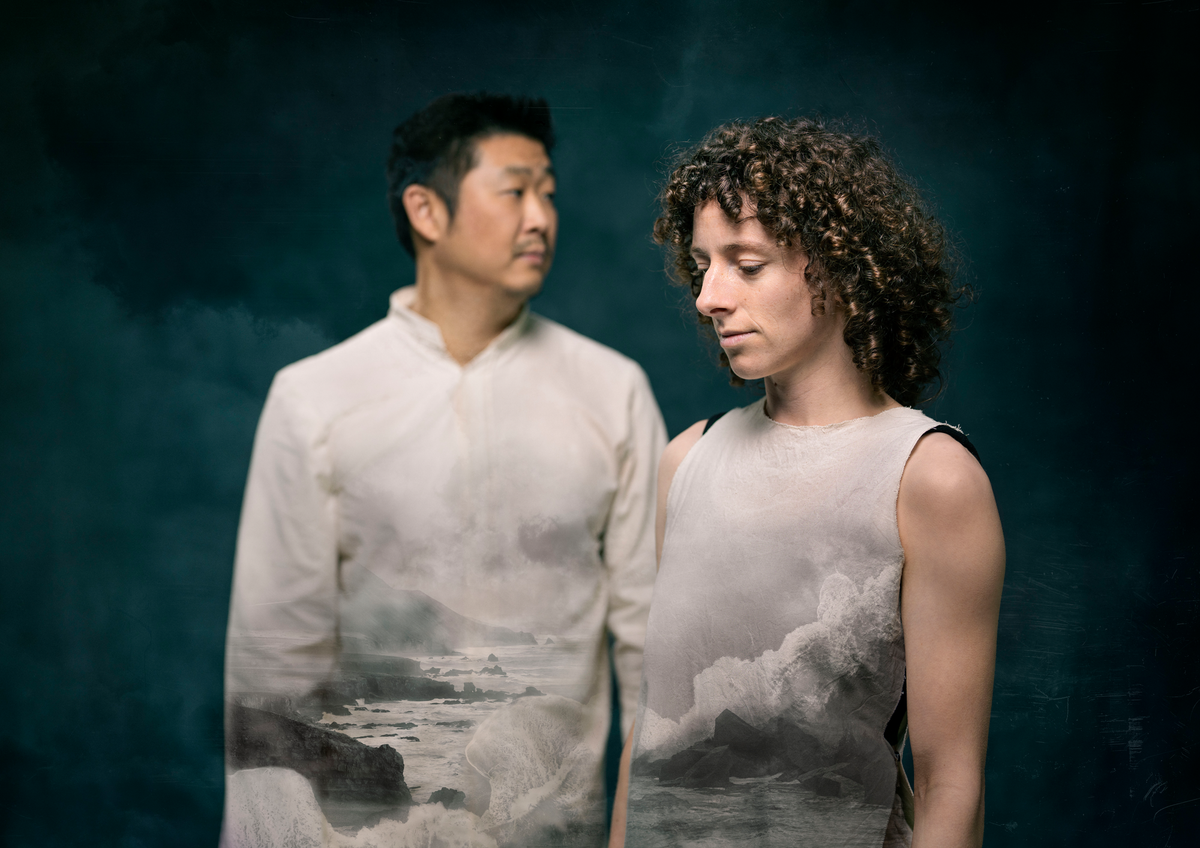
From writing punk rock songs on a guitar case to exploring 25-minute instrumentals, open tunings and cosmic existentialism, meet Yyan, one half of experimental folk duo Where Water Meets.
I'll never forget the first time I met Yyan Ng. My band was headed to his house in Launceston, Tasmania, to perform a “Kitchen Concert”. All I knew at that point was that he was a chef, designer and musician with incredible guitar chops.
We knocked on the door, and he enthusiastically welcomed us in, almost immediately jumping onto a table he'd designed himself to demonstrate how sturdy it's uniquely designed legs were. He then served us the best noodles I've ever tasted, took us to a secret swimming spot and offered us fermented cockroaches from his pantry, prepared according to an ancient Roman recipe.
The next time I saw him, he was performing his original compositions with Emily Sheppard (the other half of Where Water Meets) on instruments made out of eels.
All I'm saying is that SBS would have a slam-dunk of a show hosted by Yyan, and I'd be the first to watch it.
So naturally, I was insanely curious to know what on earth this man had been listening to. He's generously shared the songs that shaped him ahead of the release of the hotly anticipated Where Water Meets album Ashore, All to Pieces and tour.
Keep reading - and scroll down - for a special single video preview of "Koady's Jig" for Bespoke Folk readers that combines a ripping jig, chamber music, Wingrove, a doco and tribute in six glorious minutes.
Song Lore: The Songs That Built Yyan Ng from Where Water Meets
About our Song Lore series:
In this series, musicians trace their origin story through the songs that shaped them. You get to hear how those threads run through hometowns and heartbreaks, teachers and turning points, before coming together to shape an artist’s sound.
You also gets some excellent music recommendations along the way!
Listen along with the companion playlist on YouTube for the full sensory experience.
Where Yyan began
Along with us kids being obsessed with the latest Canto Pop Idol (the Big Four), Dad subscribed to Reader’s Digest, or some magazine of that kind, which had a deal where you’d get a new CD every month with your subscription. So we ended up with a whole collection of CDs featuring all the “Greats of Classical Music”.
I remember loving Strauss because it had a beat, and of course, even at seven, I loved Bach. But one memory that stands out is that Dad, for some reason (probably being UK-educated), had a few records by the emerging electronic and experimental musicians of the time, like Jean-Michel Jarre and Mike Oldfield’s Tubular Bells.
Maybe that 15/8 riff somehow, deep down, normalised our use of odd time signatures.
Tubular Bells has acoustic bells, pianos, guitars, bass and synths, and one movement is 25 minutes long, yet it was considered semi-mainstream? What a time it was for music!
Call to Adventure: the moment music hooked him
I was an MTV kid, or really, just a TV kid. It was the OG doomscrolling, I guess.
But for all the diverse music I’d been exposed to, by the time I was a teenager, this song, with its blip blops, repetitive chords and synths, and the lead singer’s lament, spoke really hard to me. I remember literally jumping up after watching it on TV, onto the bike and straight to the record store to use all my lunch money to buy my first CD - Radiohead’s Kid A.
Looking back it is not so strange, many of the elements of this song still rings true to me as a musician and a human. Climate Existentialism. Creep of nihilist technology. Experimental music that challenges what can be considered “pop” music, especially at the time. This song was a “single” from an otherwise even more impenetrable album.
It’s still one of my favourite albums of all time, and definitely one of the most artistically courageous, to my mind.
The mentors who shaped his musical DNA
I met Ed Tuleja who is a living Tasmanian legend (the guy who co-wrote “Dancing in the Moonlight”) because of our mutual love of the acoustic guitar, and he introduced me to Pierre Bensusan.
He organised some concerts and masterclasses in Deloraine and I got to bask in the genius and generosity of a master musician. He was probably 30 years into playing and between concerts was still spending 4-6 hours a day practising up in the Meander Mountains.
I was already experimenting with open tunings, but seeing someone who played solely in them literally changed my life. Bensusan’s masterclasses are still the foundation of so much of how I play. Having access to different colours of chords and a lyrical touch in the right hand has been foundational to my playing, and taking these approaches into songwriting with larger arrangements is the basis of the sound of Where Water Meets.
Crossing the Threshold: His first time stepping into the public world
The first song I wrote came about when my cousin and I went to our family clubhouse and caused some kind of trouble in the sauna or poolroom. Some older gentlemen shouted at us, saying, “You better get out!”
We went home, and I banged on the guitar case while my cousin strummed four chords, and we wrote a riff-based punk rock banger called… “Better Get Out”.
When I moved to Launceston to study, a friend gave me my first acoustic guitar, and I became obsessed with open tunings and one-chord songs, especially those from the Mississippi Delta blues tradition.
I played my interpretation of “Preachin’ Blues” at a local open mic jam, and that was when I got a standing ovation from some fellow local musicians and got my first “break”, so to speak. That’s when the gigs and calls from other musicians started coming in.
Still today, much of our Where Water Meets compositions jump between maximalist chordal and structural movements and modal explorations within a single chord.
Trials and Transformations: Touring, heartbreak, learning craft
“I’d rather be, a functioning cog in some great machinery, serving something beyond me”
I spent a year obsessively listening to Fleet Foxes’s album Helplessness Blues until my girlfriend at the time hated it. Every song had a different open tuning, and it spoke to where I was at.
I was a singer-songwriter as an adolescent, and quickly falling into the “depressed lad writing about heartbreak, finding love and falling into heartbreak again” cycle. I guess I was trying to consolidate the emerging singer-songwriter I was becoming with the serious Indian musicians I’d grown up watching perform two-hour concerts at the Temple of Fine Arts. I was trying to find a way to bring together songs about everyday blues and existential blues. I think this album was a good blueprint for how a singer-songwriter could approach both in their craft.
The Revelation
Meeting Emily Sheppard and making our first album, back when we were called ‘Yyan and Emily’, very much consolidated all the things I’ve talked about so far.
I chose these three songs because they're representative of that.
“Regions” is a direct reference to Coltrane’s Stellar Regions, bringing together ragas and Indian cyclic and cosmological concepts in a song for voice and guitar.
“Remnants” is literally one chord for 90 percent of the song, exploring existential themes of cosmic background radiation and Tasmanian Antarctic exploration.
“Shores of Innisfree” was very much the first time I discovered my unique sense of harmony and poetic lyrical writing style. It’s a love letter to coastal landscapes and waterways, the poetry of Keats, and, again, an exploration of how to incorporate all these big concepts into an arrangement for just one guitar and one voice.
“Regions” and “Remnants” both feature our friend Anne Norman on shakuhachi. Playing with Anne, alongside my own shakuhachi practice, has informed our musical sense of time, which carries through into our new album, Ashore, All to Pieces.
SPECIAL PREVIEW: KOADY'S JIG AND WINGROVE DOCUMENTARY