The Secret Architecture of Your Musical Taste
Why do some folk songs light you up while others leave you cold? This piece explores the neuroscience-inspired dimensions behind musical taste, and introduces the Folk Listener Personality Typology.

There’s a personality quiz for everything these days and I will gladly do them all. Enneagram, Myers-Briggs, even the Buzzfeed Disney Princess quiz.
But what about a quiz that that gives you clues about why one song lights you up from the inside, while another perfectly respectable song leaves you feeling meh?
Every brain is shaped to experience music differntly. The wiring of our neurons, the music we were exposed to, and the place and time we grew up in all shape what kind of listener we become, and what kinds of listening experiences reward us.
So an app can serve you an AI-generated playlist called “Happy Folky Vibes.” That does not mean it knows what will tickle your ears.
Algorithms can infer patterns, but they cannot know why a song matters to you. Too often they flatten hard-won personal taste into mood, genre or previous behaviour.
This is where your Folk Listener Personality becomes useful.
Once you know your listener type, you have a starting point: a way to find music that intrigues, compels, and rewards your particular ears.
So we created the Folk Listener Typology Quiz as a doorway into musical experiences that will actually excite you.
This didn’t come from nowhere. The quiz loosely adapts the “aesthetic dimensions” described by producer-turned-neuroscientist Susan Rogers in her excellent book This Is What It Sounds Like.
Taste is not only about genre. Two people can both say they like folk and mean completely different things. One might be chasing old songs, regional accents and unvarnished voices. Another might crave intricate arrangements, strange harmonies and acoustic instruments pushed to new sonic places.
For our Folk Listener Personality quiz, we’ve translated three of Rogers’ dimensions into folk-world tensions:
- Tradition/Novelty
- Authenticity/Construction
- Acoustic/Electronic
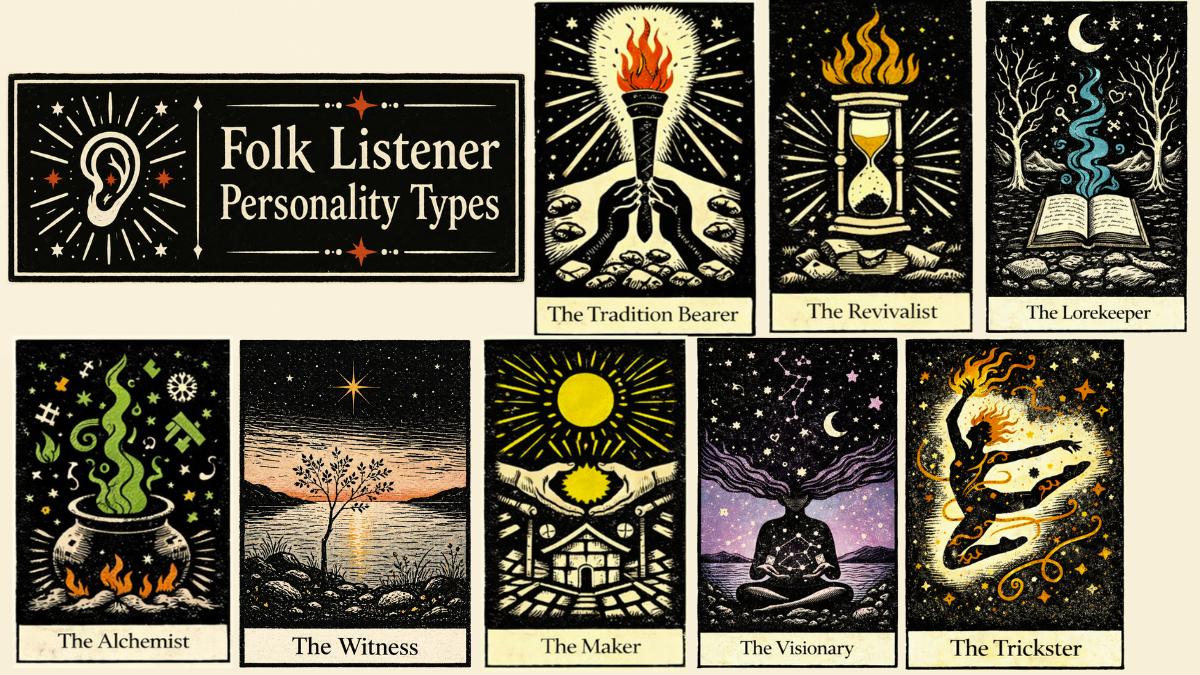
Different combinations of these dimensions create eight Folk Listener Personalities e.g. Tradition + Authenticity + Acoustic = TAA The Tradition Bearer.
But before we name the types, let’s look at the dimensions underneath them.
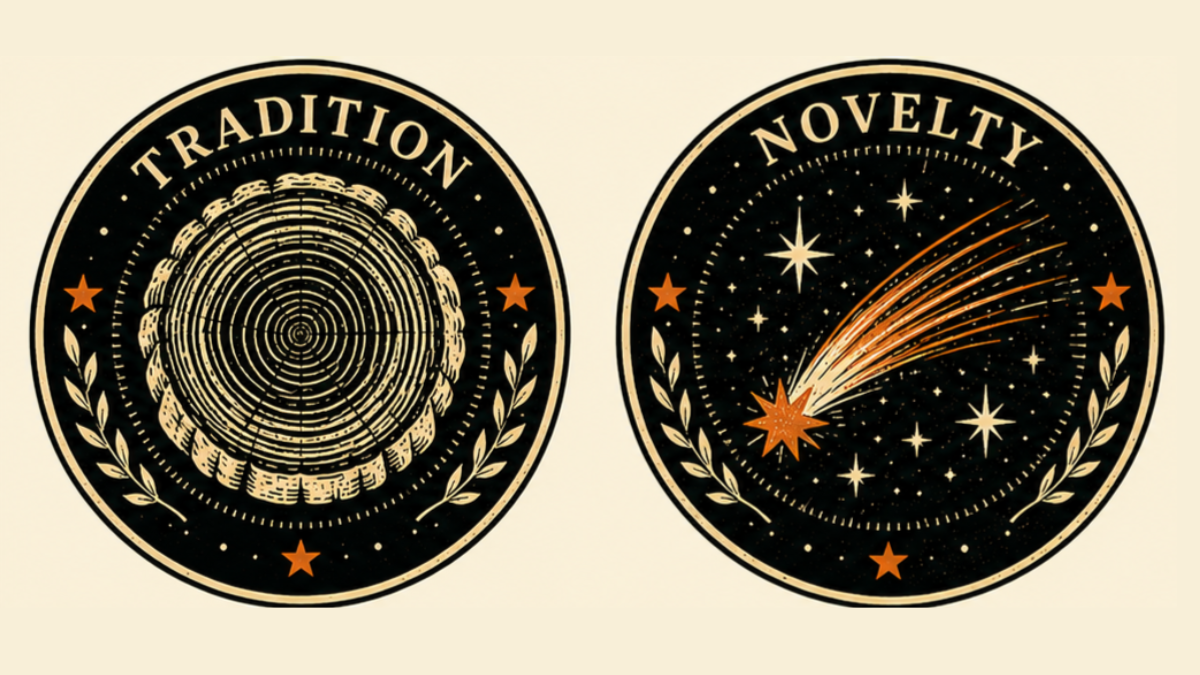
Tradition/Novelty
The first axis asks how much novelty you crave. Do you want music that deepens a known form, or music that pushes at the edge of what a song or tune can be?
Tradition
Some listeners go deep on well-established musical forms and feel rewarded by musicians who know the tradition down to its grain.
For some people, that means deep-diving on particular traditions: Celtic reels, Québécois sing-a-longs, Australian bush concertina or English murder ballads. They’re digging for the roots of music and history.
You know the friend who nerds out on bluegrass and can describe the nuances of every picker’s solo on “Salt Creek.”
Tradition does not only mean old recordings. It can also mean new music that works deeply inside an established form. Think of Gillian Welch writing songs that sound as old as the hills with perfectly placed word setting.
Novelty
Other listeners crave novelty: new sounds, new structures, new musical experiences.
Artists at this end of the spectrum are often ahead of their time. They might sell only a hundred records in their lifetime, but every person who buys one starts a band.
They may begin inside a tradition, then get restless: bending form, instrumentation, harmony and melody. They test how far a song or tune can stretch before it becomes something else.
In the middle?
But I like both of these, you might think. Don’t make me pick!
Often, the most popular music sits near the middle of the Novelty-Popularity curve: familiar enough to enter easily, strange enough to feel newly charged. Kind of like keeping the recipe the same but changing the ingredients.
Think of Mumford & Sons’ “Little Lion Man” topping Triple J’s Hottest 100 of 2009. For listeners raised on confessional rock and indie anthems, banjo, three-part male harmony and a joyful stomp felt just novel enough to make a breakup song feel new and take over the radio.
Most people are not pure types. If both ends of an axis pull at you, explore your "Personality Wings"
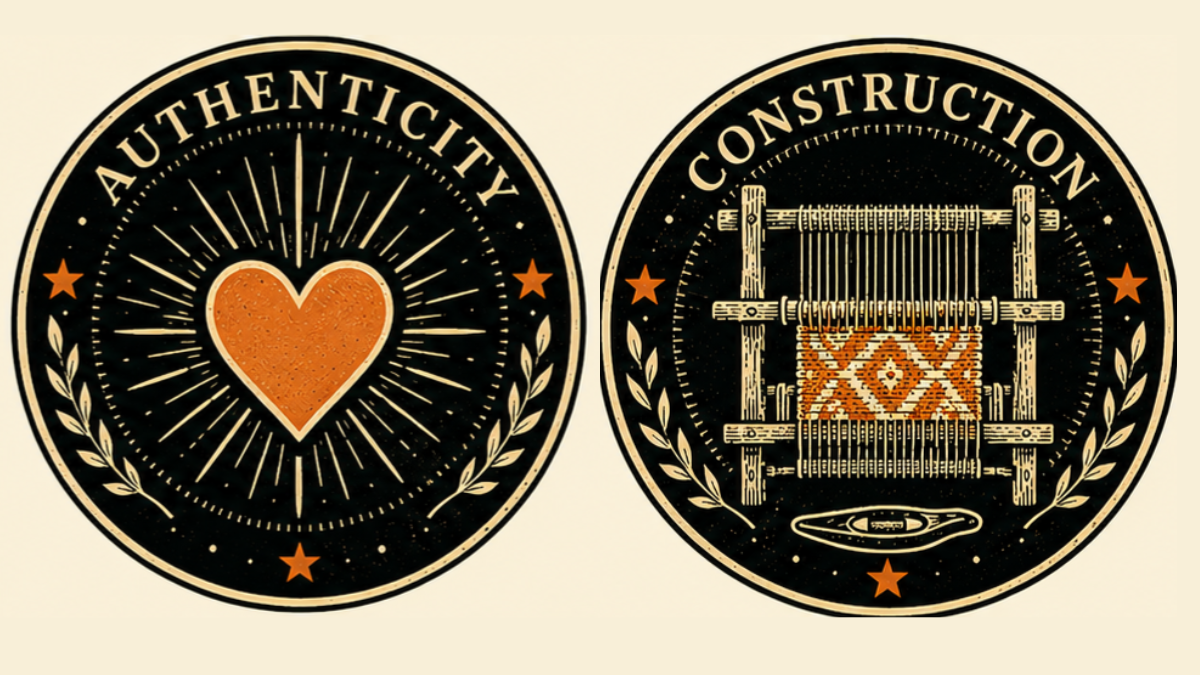
Authenticity/Construction
Rogers frames this dimension as a spectrum between “naïve art” and “cerebral music.” In our quiz, we translate that into Authenticity and Construction.
Authenticity
Rogers describes authenticity as the “subjective conviction that the emotion expressed in a musical performance is genuine and uncontrived.”
In this framework, authenticity does not mean “better” or “more morally pure.” It means the listener experiences the performance as direct, unguarded, unpolished, or emotionally immediate. Rogers describes it as “music from the neck down”.
This is the pleasure of hearing something that feels as if it has travelled straight from feeling to sound: a cracked voice, a rough edge, a breath left in the recording, the sense that nobody has polished the life out of it.
Construction
Music on the constructed side can still feel all the feelings, but its force comes through craft: arrangement, structure, harmony, production, precision and pattern. Rogers calls this “music from the neck up.”
In folk terms, this might be the difference between a field recording that keeps every creak in the chair and a carefully arranged chamber-folk record where every harmony, pause and instrumental colour has been placed with jeweller’s tweezers.
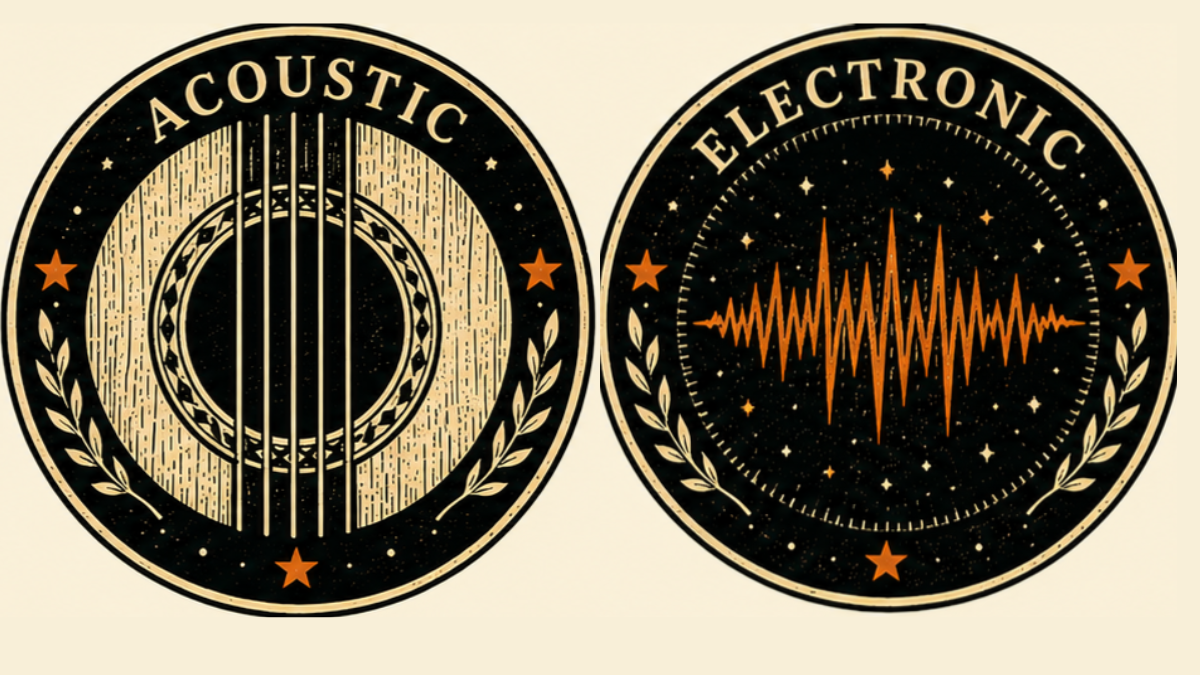
Acoustic/Electronic (or, Abstract/Realism)
This axis asks what kind of sound world wakes you up. Do you prefer sounds rooted in analogue realism? Or do you light up when technology opens a stranger sonic world?
Rogers defines this as “Realism versus Abstraction”. Her test is simple: close your eyes while you listen and notice what you visualise. If you visualise the musicians performing, you may lean toward realism. If you visualise scenes, shapes and sights, you may prefer the abstract.
Folk is often imagined as acoustic-only, and there are good reasons for that. So much of its history and power comes from bodies in rooms: breath, wood, gut, skin, metal, hands, floorboards. But folk has never been untouched by technology. In fact, folk has always been a technology of transmission: voices calling across fields, fiddles carried in suitcases, broadside ballads, wax cylinders, radio, records, festival stages, YouTube clips, loops.
Computers gave musicians new ways to manipulate sound beyond what wood and strings could do. We could create abstract sound worlds by looping, layering and distorting tone itself. We could plug our instruments into electronics and set our musical imaginations free.
This is where the folk world starts getting controversial: Dylan goes electric while Pete Seeger sharpens his axe.
Joke, of course. Seeger never actually cut the cord with the axe, but the legend tells you something about how charged this argument became.
Some folk artists now build with loops, samples and electronics. Others still love the grain of acoustic sound: wood, breath, string, room.
So the question is not purity. The question is: what kind of sound world wakes you up?
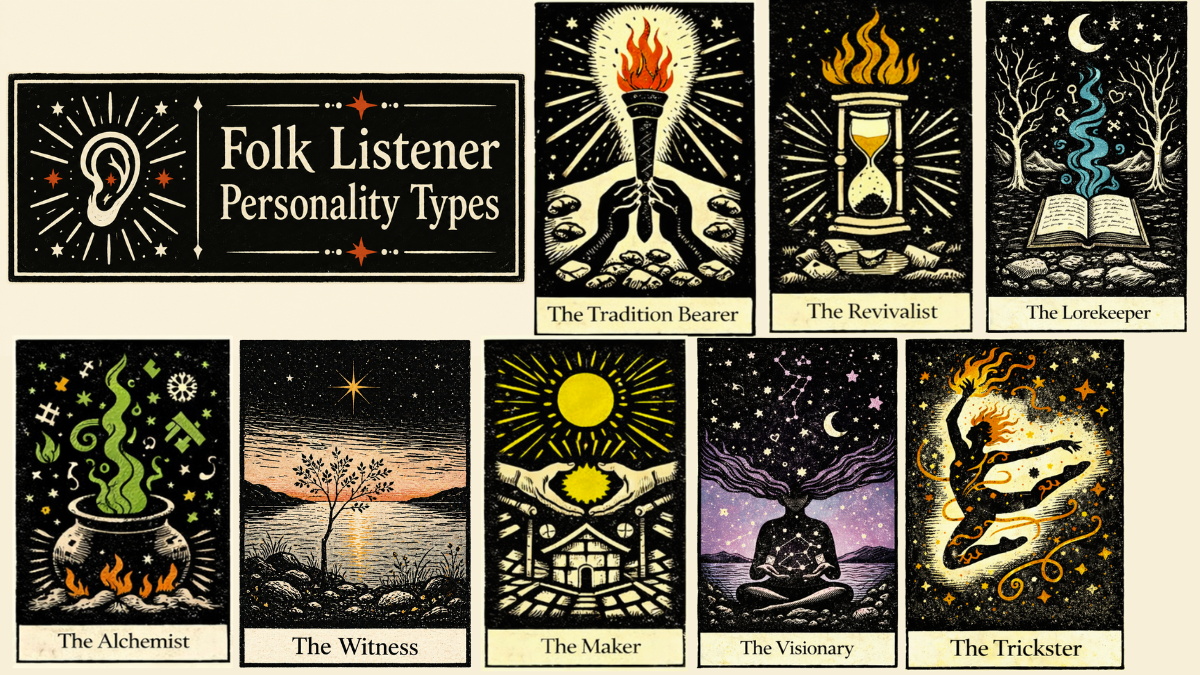
So what Folk Listener Personality are you?
Take each dimension, notice where your preferences sit, and see which Folk Listener Personality emerges.
Are you a...
- TAA — The Tradition Bearer (Tradition/Authenticity/Acoustic)
- TAE — The Lorekeeper (Tradition/Authenticity/Electronic)
- TCA — The Revivalist (Tradition/Constructed/Acoustic)
- TCE — The Alchemist (Tradition/Constructed/Electronic)
- NAA — The Witness (Novelty/Authenticity/Acoustic)
- NAE — The Visionary (Novelty/Authenticity/Electronic)
- NCA — The Maker (Novelty/Constructed/Acoustic)
- NCE — The Trickster (Novelty/Constructed/Electronic)
We made a quiz to do the sorting for you.
Use these Personality Types as a starting place for noticing the patterns in your playlists, and the pleasures your ears keep returning to.
Click here to read more about your type and its wings, then explore the playlists, artists and listening pathways we’ve curated for you.
Let the listening adventure begin!